Javascript Menu by Deluxe-Menu.com
 
 
ME Mechanical - Seats are available for 2010-11. Kindly contact admission cell immediately.
 
NRI admissions are open for all Bachelor of Engineering (BE) and Master of Engineering (ME) program.
NRI permissions are approved by AICTE
Download Admission Docket 2010 -2011

   About the Institution

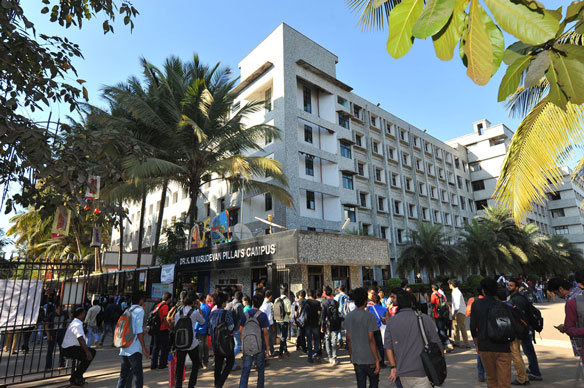
Pillai’s Institute of Information Technology, Engineering, Media Studies & Research (PIIT) seeks to inculcate in its students a sound technical foundation and provides every stimulus for the natural curiosity of student to develop. We firmly believe that a successful engineer is one who complements his in-depth theoretical knowledge with an intuitive practical approach.

Our focus is all round development of students. The spacious campus is well suited to extra-curricular activities such as sports and cultural events.

Courses Offered

We offer following six Under Graduate courses in engineering:

  • B.E.(Electronics & Telecommunication)

  • B.E.(Computer)

  • B.E.(Information Technology)

  • B.E.(Mechanical)

  • B.E.(Electronics)

  • B.E. (Automobile)

We also offer following four Post Graduate courses:

  • M.E.(MechanicalCAD/CAM Design)

  • M.E.(Information Technology)

  • M.E. (Electronics)

  • M.E. (Computer)

Course Duration
Under Graduate courses in engineering (B.E.) four years
Post Graduate courses in engineering (M.E.) two years


Language of Instruction

Language of Instruction for all the above courses is ENGLISH.
 

  Computer Engineering

The B.E. Computers course is very much in demand by those planning a career in the industry or hoping to pursue research at the post graduate level. The objective of the course is to build strong fundamentals in the subject. Core subjects like System Software, Operating Systems, Computer Organisation, and Theory of Computations prepare students for a wide variety of career options.


  Information Technology

Though a relatively new introduction to the engineering stream, Information Technology is a very popular choice amongst students who wish to specialise in information systems. Some of the core courses offered here are Software Engineering, Networking, Signal Processing, Simulation and Modelling, Embedded Software, etc. Career options include code development and testing opportunities in IT organizations. Students may also extend their studies at the post-graduate level.


  Electronics Engineering

B.E. Electronics is a challenging course allowing several specialisations such as VLSI design, Microprocessor Design, Robotics, Embedded Systems and Communications (Satellite / Mobile / Basic), etc. An electronics student has the option of selecting a career path in Software, IT, Electronics and Telecommunication.


  Mechanical Engineering

A classic engineering stream, it is nevertheless a popular choice for the discerning student. Offering core courses such as Thermal Engineering, Fluid Mechanics, and Theory of Machines among others, it prepares students for a variety of future options including Structural Engineering, Robotics and Mechatronix.


  Electronics & Telecommunication Engineering

B.E. Electronics & Telecommunication Engineering is tailored for students who want to take an advantage of the colossal emerging opportunities in the telecommunication global market place. The course exposes students to Digital, Power and Industrial Electronics subjects and helps them develop a core competency in Telecommunication Technologies. A series of other subjects enables students to leverage convergence of technologies leading to Mobile & Wi-Fi Telecommunication devices and products.


  Automobile Engineering

Automobile engineering or automative engineering is the branch of engineering which deals with the study as how to design, manufacture and operate automobiles like buses, trucks, cars etc. and also thier respective engineering subsystems. This can also be a grouped under vehicle engineering.

An automobile engineer's main duty is to design, test and develop vehicles and/or components from concept stage through to production stage. The vehicle after being launched in the market also needs improvement. Then it comes to the duty of the automobile engineer to improve the vehicle in response to customer's feedback.

Automobile engineers further can specialize in the areas such as aerodynamics, alternative fuels, chassis, electronics, emissions, ergonomics, manufacturing, materials, motor sport, power train, rapid prototyping, vehicle and pedestrian safety or supply chain management etc. The responsibility of automobile engineer is always in maintaining the high standard of vehicle by the use of traditional methods and state-of-the-art technology.

In recent times, owing to the rapid growth of automobile industries in the country, the demand for skilled professionals has also been increased considerably. Hence opting for a career in automobile engineering will be interesting as well as rewarding.


Eligibility Criteria


  Eligibility of Maharashtra State candidate and Outside Maharashtra State (OMS)
    candidate to appear for MHTCET- 2008:

A candidate should be an Indian National and should have passed/appeared* for the HSC (Std. XII) examination of the Maharashtra State Board of Secondary and Higher Secondary Education, or its equivalent examination, with English, Physics, Chemistry and Mathematics.

Note:

Candidates who have appeared for the qualifying examination, i.e., HSC (Std. XII) or its equivalent examination during the academic year 2007-08 and whose results are not declared till the last date of submission of application form are eligible to appear for MHTCET-2008; however for admission to the First year of degree courses in Engineering / Technology, such candidates must fulfill the eligibility criteria as mentioned in rules 2.2 to 2.10 as applicable.

Maharashtra State candidates (defined as per rule no. 3.1) and Outside Maharashtra State (OMS) candidates (defined as per rule no. 3.2) are eligible to appear for the MHTCET-2008 conducted by a competent authority of the Government of Maharashtra for the academic year 2008-2009.

Even though OMS candidates are eligible to appear for the MHTCET- 2008, it is specifically made clear that such OMS candidates will not be able to participate in the Centralised Admission Process on the basis of their score in MHTCET 2008. OMS candidates will be able to apply for admission against the institute level seats as well as the vacancy round of admission after completion of the Centralised Admission Process ONLY in Unaided Private Engineering Colleges/Institutes on the basis of their score in MHTCET 2008.

The facility of Constitutional Reservation (Annexure-II) is not available for OMS candidates. All OMS candidates will be treated as OPEN / GENERAL category candidates for the entire admission process.


  Eligibility criteria for Maharashtra State candidate and Outside Maharashtra State (OMS)
    candidate for admission to the First year of degree courses in Engineering/Technology:

A candidate should be an Indian National who has passed the HSC (Std. XII) examination of the Maharashtra State Board of Secondary and Higher Secondary Education, or its equivalent examination, with English, Physics, Chemistry and Mathematics. Minimum 50% marks are required, i.e., not less than 150 marks out of 300 marks (minimum 45% marks, i.e., not less than 135 marks out of 300 marks in case of candidates of Backward Class categories belonging only to Maharashtra State) in the subjects Physics, Chemistry and DTE, Mumbai, MHT-CET 2008 Brochure Engineering/Technology Mathematics added together; AND a non zero score in subjects Physics, Chemistry and Mathematics added together at MHT-CET 2008.


  Eligibility Criteria for Foreign National/Foreign Student/ PIO/Children of Indian workers
    in the Gulf countries/Children of NRI:

A candidate should have passed the HSC (Std. XII) examination of the Maharashtra State Board of Secondary and Higher Secondary Education, or its equivalent examination, with English, Physics, Chemistry and Mathematics; minimum 50% marks are required, i.e., not less than 150 marks out of 300 marks in Physics, Chemistry and Mathematics added together.

  • NRI candidates are eligible to apply for admission against the institute level seats only in Unaided Private Engineering Colleges/Institutes. The extent to which such NRI candidates shall be admitted is limited to 15% of the sanctioned intake.

  • The eligibility of candidates passing the HSC (Std. XII) equivalent examination from a school/college/Examination Board situates outside India shall be further decided by the authorities of the University to which the candidate seeks admission. Hence such candidates are advised to get their eligibility verified by the respective University authorities before seeking admission to Engineering courses in the State of Maharashtra.

  • Candidates belonging to this category are not required to appear for the MHT-CET 2008/AIEEE 2008.

For further details visit www.dte.org.in
 

  Exam Schedule

Visit: http://www.mu.ac.in.


News


  Information Technology Department News

Infosys Campus connect programme flagged off
Doordarshan hosts talk show on campus
BARC Golden Jubilee & University of Mumbai Sesquicentennial celebrated at PIITEMSR
Personal development workshop conducted
Dr. B. Menezes (HOD, KReSIT) speaks on Network & Data Security
Engineers' Day initiative
 

  Electronics Engineering Department News

Digital Signal Processing and its Applications
Radiation and Isotopes: Tools for betterment of mankind
Engineers Day Celebration
Refinery Processes and associated technological problems
Control Systems for Power Plants
Embedded Systems and VLSI Design
Training on PLC and its use in automation
Global Positioning System (GPS)
 
Read More Details - Visit Our Site:
www.piit.ac.in